Building Your First Supplement Stack on a Budget
New to supplements and overwhelmed by the wall of tubs at your local Dubai supplement store? Here is the no-nonsense beginner's guide — what to buy, in what order, and how to spend your dirhams where they actually count.
Walk into any supplement store in Dubai or Abu Dhabi and the experience can be genuinely overwhelming. Wall-to-wall tubs, aggressive marketing claims, salespeople with strong recommendations, and price points ranging from AED 60 to AED 800 for products that might do the same thing or might do nothing at all. For someone new to the supplement world, the cognitive load is enormous.
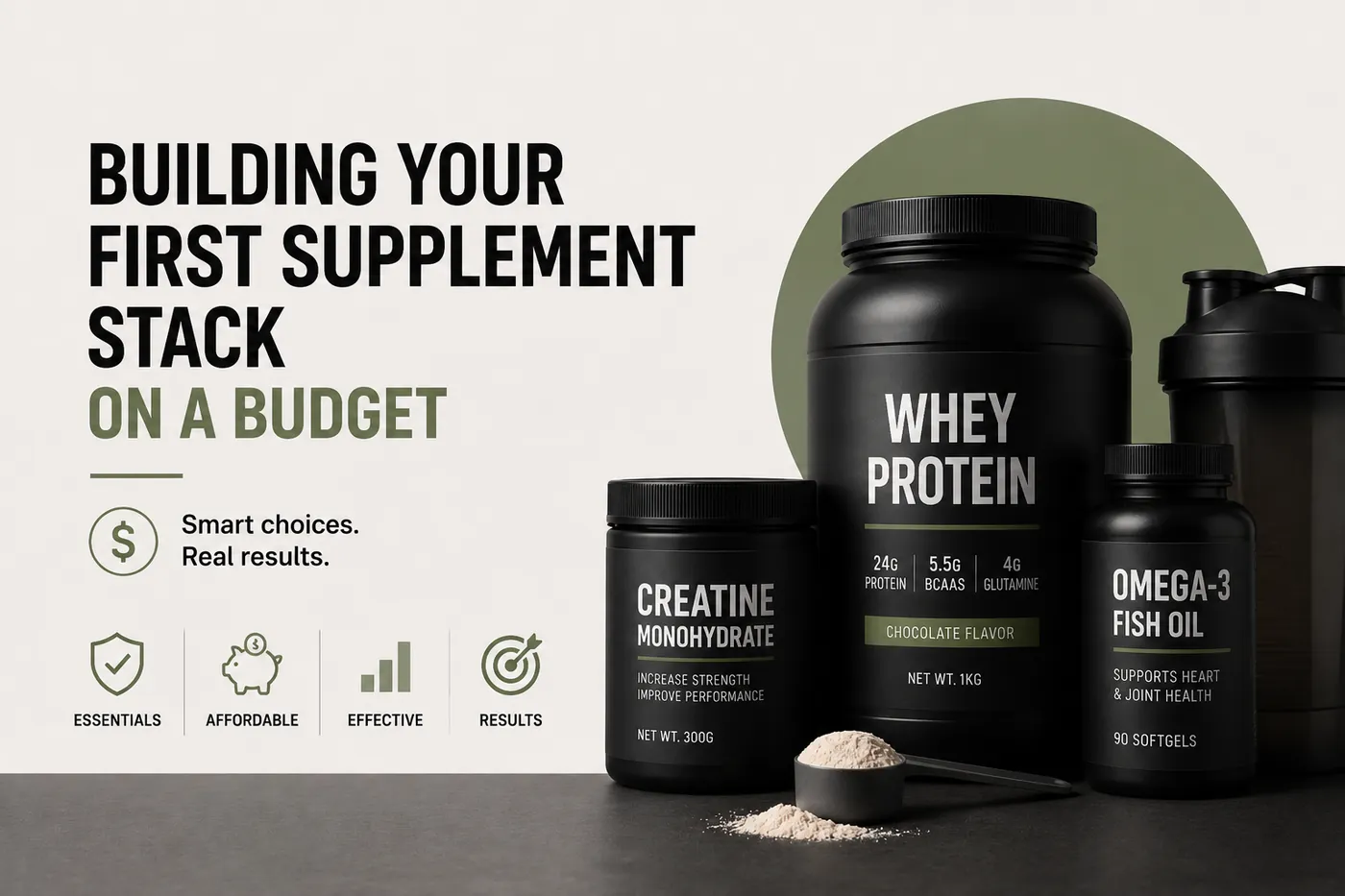
The reality is far simpler than the supplement industry wants you to believe. For someone starting out — or someone looking to build a rational, evidence-based stack without wasting money — the answer fits in three products, most of which should cost less than AED 300–400 per month combined. Everything beyond that is optional, and most of it can wait until the foundations are working.
The Foundation: Why Only Three Supplements Matter for Beginners
The supplement industry earns its revenue by convincing consumers they need more than they do. The truth is that the large majority of training progress in the first one to three years comes from four things: consistent training, sufficient protein, adequate sleep, and managing recovery. Supplements can support these but cannot replace them.
For a beginner, the two most common limiting factors are:
- Not eating enough total protein to support muscle growth and recovery
- Not being consistent with training and recovery habits
The three supplements that directly address these limiting factors, supported by the strongest evidence in sports nutrition research, are: whey protein, creatine monohydrate, and a quality multivitamin. Everything else should be considered only after these are established habits.
Supplement One: Whey Protein
The single most useful supplement for the majority of athletes is a quality whey protein powder. Not because protein shakes are magic, but because most people struggle to consistently hit their daily protein targets (1.6–2.2g per kg of bodyweight) from whole food alone — particularly with a busy UAE lifestyle of long work hours, frequent business travel, and inconsistent mealtimes.
Whey protein is:
- A complete protein source with an excellent amino acid profile
- Rapidly absorbed — ideal around training
- Calorie-efficient relative to its protein density
- Convenient — mixed in 30 seconds, consumed anywhere
- Versatile — mixable into meals, oats, yoghurt, or water
What to look for: a product with 20–25g of protein per serving, minimal unnecessary fillers or sugar, and from a brand with third-party testing or halal certification if that matters to you. Do not pay extra for "advanced" whey forms (hydrolysate, micro-filtered) as a beginner — concentrate or isolate from a reputable brand is completely effective and more cost-efficient.
Approximate UAE cost: AED 150–280 per month (depending on brand and daily usage)
Supplement Two: Creatine Monohydrate
Creatine monohydrate is pound-for-pound the most effective performance supplement available — backed by over 500 peer-reviewed studies and consistently showing benefits for strength, power output, training volume capacity, and lean mass gain. It is also one of the cheapest supplements available when purchased as a standalone product.
For beginners: take 3–5g daily, consistently. You do not need to load. You do not need to cycle it. You do not need an expensive form — plain creatine monohydrate is the form used in essentially all the research and outperforms more expensive alternatives in head-to-head comparisons.
The benefit for beginners is particularly significant because the strength and training capacity improvements creatine enables allow you to train harder in your early months — creating more total training stimulus and faster adaptation.
Approximate UAE cost: AED 40–100 per month (standalone creatine monohydrate)
Supplement Three: A Quality Multivitamin
A broad-spectrum multivitamin fills the micronutrient gaps that are common even in well-intentioned diets — particularly relevant for UAE residents who are at elevated risk of vitamin D insufficiency (due to indoor lifestyles despite abundant sunshine), and for athletes whose elevated sweat losses in the UAE heat increase magnesium and zinc requirements.
Look for a multivitamin that includes meaningful vitamin D (ideally 1,000IU minimum), uses chelated mineral forms for better absorption, and carries a halal certification or third-party testing mark. Avoid mega-dose formulas that provide several thousand percent of the RDA for any individual nutrient.
Approximate UAE cost: AED 50–120 per month
Month-by-Month Beginner Timeline
- Month 1–2: Establish your protein intake using whey to supplement meals. Track approximately how much protein you are consuming per day against your bodyweight target. This single habit change drives more progress than any other supplementation decision.
- Month 2–3: Add creatine monohydrate once your protein habits are consistent. Take 5g daily with any meal or drink. Note changes in strength and training capacity over 4–6 weeks.
- Month 3+: Add a multivitamin as a safety net. At this point, review whether your training and dietary foundations are in place before considering additional supplements.
Understanding Supplement Labels When Buying in the UAE
Product labelling in the UAE can be confusing for first-time buyers — imported products carry original country labelling alongside (sometimes) an Arabic sticker with UAE-specific information. Key things to check regardless of origin:
- Serving size and servings per container: Marketing often leads with "40g of protein" but that may be a two-scoop serving size with only 15 servings per tub — meaning a very expensive cost per gram of protein. Calculate cost per gram of protein as a comparison metric.
- Ingredient list order: Ingredients are listed by weight. If whey protein is not the first or second ingredient, or if the first ingredients are maltodextrin or sugar, the product is lower quality.
- Halal certification: Look for a recognised UAE-accepted halal mark. Not all imported products are halal certified — check carefully if this is a requirement for you.
- Expiry date: Ensure the product has a reasonable shelf life remaining. Some grey-market products arrive in the UAE close to expiry.
Where to Buy Supplements in the UAE
Purchasing from an authorised retailer is the most important decision a UAE supplement buyer makes. The UAE market has a notable counterfeit problem particularly in protein powder and creatine — categories where the white-powder format makes adulteration easy and difficult to detect visually.
Safe purchasing options:
- Authorised online retailers like JNK Nutrition — who source directly from official brand distributors and maintain full product traceability
- Established physical supplement stores in UAE malls and sports districts with verifiable supplier relationships
- Official brand websites that ship to the UAE directly
Avoid: informal social media sellers, gym locker-room resellers, and any product priced dramatically below the established UAE market rate. The saving is not worth the health risk.
Common Beginner Mistakes to Avoid
- Buying before the basics are in place. No supplement compensates for 5 hours of sleep, an inconsistent training programme, or a daily diet of ultra-processed food. Get those right first.
- Buying too many things at once. If you add five new supplements simultaneously, you will have no idea which, if any, are making a difference. Start with one, establish a baseline, add the next.
- Buying expensive when cheap works. Plain creatine monohydrate, basic whey concentrate, and a mid-range multivitamin are equally effective as their premium-priced counterparts. Spend the budget difference on food quality.
- Expecting dramatic results from supplements. Supplements augment — they do not build. The work in the gym and the kitchen builds the physique. Supplements make the process marginally more efficient.
Start simple, build consistency, and layer in additional supplements only when the foundations are habit. The JNK Nutrition app and online store makes it easy to find the right beginner-level products with full transparency on ingredients, dosing, and pricing in AED.
Frequently Asked Questions
What are the three most important supplements for beginners?+
Whey protein (to help hit daily protein targets conveniently), creatine monohydrate (the most evidence-backed performance supplement for strength and muscle growth), and a quality multivitamin (to address common micronutrient gaps, particularly relevant for UAE residents who commonly have low vitamin D). Everything else is optional until these three are consistent habits.
How much should I budget for a beginner supplement stack in the UAE?+
A sensible beginner stack — whey protein, creatine monohydrate, and a basic multivitamin — should cost approximately AED 240–500 per month depending on the brands chosen and usage frequency. Plain creatine monohydrate is very inexpensive (AED 40–100/month). Most of the budget goes to whey protein (AED 150–280/month).
Do I need to load creatine when starting out?+
No. Simply taking 3–5g daily consistently is all you need. A loading phase (20g/day for 5–7 days) fills muscle creatine stores faster but produces the same long-term outcome as a simple daily maintenance dose taken consistently. For beginners, patience and consistency matter more than loading protocols.
Where is the safest place to buy supplements in the UAE?+
Buy from authorised retailers who source directly from official brand distributors — either established online retailers like JNK Nutrition or licensed physical supplement stores. Avoid grey-market social media sellers or products priced significantly below market rate. The UAE has a notable counterfeit supplement problem in categories like protein powder and creatine.
Should I take pre-workout as a beginner?+
It is better to delay pre-workout until your foundational habits (protein, creatine, sleep, consistent training) are established. Pre-workouts introduce caffeine and stimulants that can disrupt sleep, and beginners often overestimate how much of a training boost they actually need. Your early training gains come from neurological adaptation — not from stimulants.