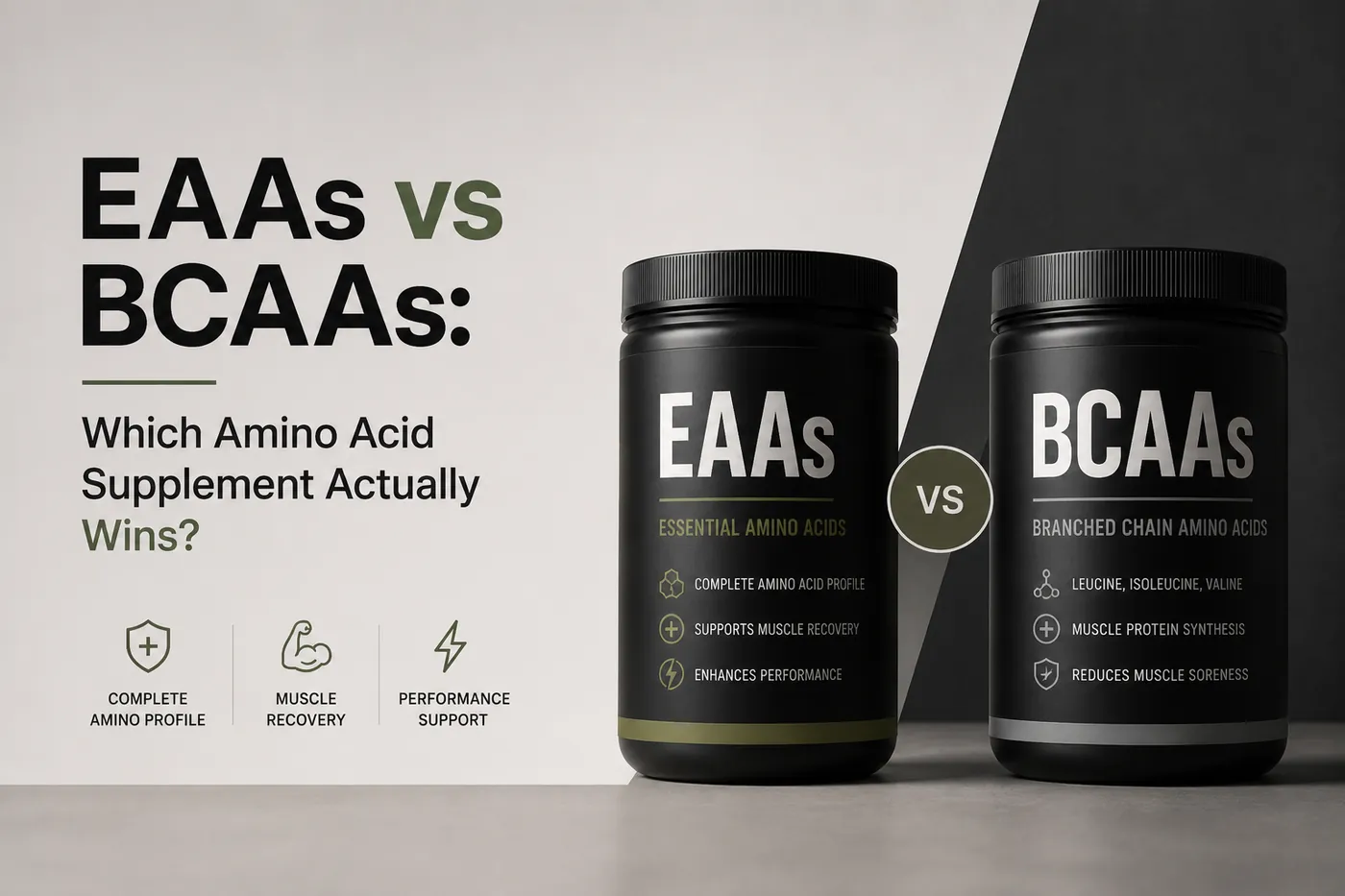
EAAs vs BCAAs: Which Amino Acid Supplement Actually Wins?
BCAAs dominated shelves for years, but essential amino acids deliver the complete picture. We compare both head-to-head — including why EAAs make particular sense for Ramadan athletes and those training fasted.
For most of the 2000s and 2010s, BCAAs were the intra-workout supplement. Every gym bag had a shaker of them. Every supplement store dedicated half its shelf space to them. Then the research caught up — and the picture became considerably more interesting.
The question is not really BCAA versus EAA in the abstract. It is a question of what your body actually needs to build and preserve muscle, and whether your current diet and training situation creates a genuine gap that supplemental amino acids can fill. The answer matters more for some athletes than others — particularly those training fasted, managing limited eating windows, or navigating the specific demands of Ramadan.
The Nine Essential Amino Acids
Amino acids are the structural units of protein — 20 in total, of which 11 can be synthesised by the body (non-essential) and 9 must be obtained from the diet (essential). The nine essential amino acids (EAAs) are:
- Histidine
- Isoleucine (a BCAA)
- Leucine (a BCAA)
- Lysine
- Methionine
- Phenylalanine
- Threonine
- Tryptophan
- Valine (a BCAA)
All nine are required for muscle protein synthesis (MPS) to proceed. Missing any one of them creates a rate-limiting bottleneck — the body cannot complete the process regardless of how much of the other eight are available.
What BCAAs Are and What They Do
Branched-chain amino acids are the three EAAs with a branched side chain: leucine, isoleucine, and valine. They make up approximately 35% of the essential amino acids found in muscle protein and are among the primary amino acids oxidised during exercise.
BCAAs — and specifically leucine — are powerful triggers for muscle protein synthesis. Leucine activates the mTOR signalling pathway, the primary intracellular switch for MPS. This is why the concept of BCAA supplementation made intuitive sense: provide the trigger amino acid, stimulate synthesis, build muscle.
The problem: stimulating the MPS signal is not the same as completing the MPS process. Leucine can activate the pathway, but without all nine essential amino acids present as building material, synthesis cannot proceed to completion. A BCAA supplement provides three of the nine required inputs — which is like pressing the ignition on a car that is missing six spark plugs.
Where BCAAs Still Make Sense
This does not mean BCAAs are entirely without merit. There are specific contexts where they provide genuine value:
- Reducing exercise-induced muscle soreness (DOMS): Multiple studies confirm that BCAA supplementation — particularly leucine — reduces post-exercise muscle damage markers and perceived soreness. This is independent of the muscle-building question.
- Reducing central fatigue during prolonged exercise: Tryptophan competes with BCAAs for transport across the blood-brain barrier. By elevating plasma BCAA levels, supplementation can theoretically reduce tryptophan uptake in the brain, blunting serotonin production and the sense of mental fatigue during long endurance sessions.
- Palatability and hydration: Many people find flavoured BCAA drinks a useful way to increase fluid intake during training. This is a valid, if expensive, hydration strategy.
- Athletes already meeting daily protein targets: If you are consistently hitting 1.6–2.2g/kg of protein per day from complete protein sources, BCAAs provide marginal additional benefit. They are a redundant supplement for well-fed athletes.
Why EAAs Have the Edge
An EAA supplement provides all nine essential amino acids in ratios approximating those found in muscle protein. By doing so, it delivers both the MPS trigger (leucine) and the complete suite of raw materials the body needs to capitalise on that trigger. Studies directly comparing EAAs versus BCAAs for MPS consistently show that EAAs produce a greater and more sustained synthesis response.
A 2017 study in the American Journal of Physiology found that an EAA blend stimulated MPS approximately twice as effectively as an equivalent dose of BCAAs alone. Subsequent research reinforced this finding. When protein synthesis support is the goal, EAAs are the more complete tool.
EAAs become most valuable in specific contexts:
- Fasted training: When no protein has been consumed for several hours before training, circulating amino acid levels are low. An EAA supplement provides an immediate complete amino acid source without requiring digestion of whole protein food — making it ideal for early morning sessions, pre-cardio use, or any scenario where training happens in a fasted state.
- Calorie-restricted phases: During a calorie deficit, the risk of muscle catabolism increases. Ensuring all nine EAAs are available during and around training provides a potent anti-catabolic stimulus without adding significant calories.
- Athletes with low protein intakes: Those who struggle to consistently hit protein targets — vegans, plant-based athletes, or those with limited appetites — benefit more from EAA supplementation than those already meeting their daily targets from whole-food sources.
EAAs for Ramadan Athletes
The Ramadan fasting window creates a specific use case where EAAs offer meaningful practical benefit. For athletes who choose to train during the fast — which is a valid choice for those who prefer it — an EAA supplement provides muscle protein synthesis support without technically "breaking" the fast from a pure caloric standpoint (though scholars differ on this; athletes should consult their own religious guidance).
More practically: athletes who train in the period immediately before Iftar, or who train late at night and cannot eat a full meal directly after, can use an EAA supplement to bridge the gap between training and their next full meal. The complete amino acid profile helps maintain a positive muscle protein balance in circumstances where whole-food options are not immediately available.
Halal Certification: What to Check in the UAE
Amino acid supplements — both BCAAs and EAAs — can be derived from various sources including animal-based fermentation, plant-based fermentation, or human hair (yes, this is used in some lower-quality products). For Muslim athletes in the UAE, halal certification is an important purchasing consideration.
When evaluating amino acid supplements:
- Look for a recognised halal certification mark from a reputable Islamic authority
- Plant-derived or fermentation-derived amino acids (from corn, wheat, or microbial fermentation) are generally considered halal
- Contact the brand's customer service directly if the sourcing is unclear on the label
- JNK Nutrition's team can advise on specific products — halal certification status is available for each product in our range
The Verdict: Which Should You Take?
If your daily protein intake consistently meets your targets from quality whole-food or supplement sources, neither BCAAs nor EAAs are likely to provide significant additional benefit. Protein timing and total intake already cover the MPS bases.
If you regularly train fasted, are in a calorie deficit, observe Ramadan, or struggle to hit daily protein targets from diet alone — EAAs are the more complete choice. They provide the full suite of amino acids required for MPS where BCAAs only partially address the need.
BCAAs are not useless — they have genuine value for muscle soreness and as an intra-workout drink. But if you are choosing between the two for muscle support and your budget allows only one, EAAs deliver more for your dirham.
Explore the amino acid supplements available at JNK Nutrition — each listing includes information on sourcing and halal certification status.
Frequently Asked Questions
Are EAAs better than BCAAs for muscle building?+
Yes, for most athletes. EAAs provide all nine essential amino acids required for muscle protein synthesis to complete, while BCAAs only provide three. Research consistently shows EAAs stimulate greater and more sustained muscle protein synthesis than an equivalent dose of BCAAs alone.
Should I take BCAAs or EAAs during Ramadan fasting?+
EAAs are the more practical choice for Ramadan athletes. If you train during the fast, an EAA supplement provides complete amino acid support for muscle preservation without significant caloric intake. If training just before or after Iftar, whole-food protein at your meal is equally effective.
Can I take EAAs on an empty stomach?+
Yes. Unlike whole protein foods, free-form amino acids do not require digestion and are absorbed rapidly even in a fasted state. This makes EAAs an effective option for early morning fasted training or any session where you have not eaten for several hours.
Do I need amino acid supplements if I already eat enough protein?+
Generally not. If you consistently consume 1.6–2.2g of protein per kg of bodyweight per day from complete protein sources (meat, dairy, eggs, or quality protein supplements), your amino acid needs are already covered. Supplemental EAAs or BCAAs become more valuable when protein intakes are inadequate or inconsistent.
Are amino acid supplements halal?+
It depends on the source and manufacturer. Many amino acid supplements use plant or microbial fermentation-derived amino acids that are halal. Look for a recognised halal certification mark on the product, or check directly with the brand. The JNK Nutrition team can advise on specific products in our range.