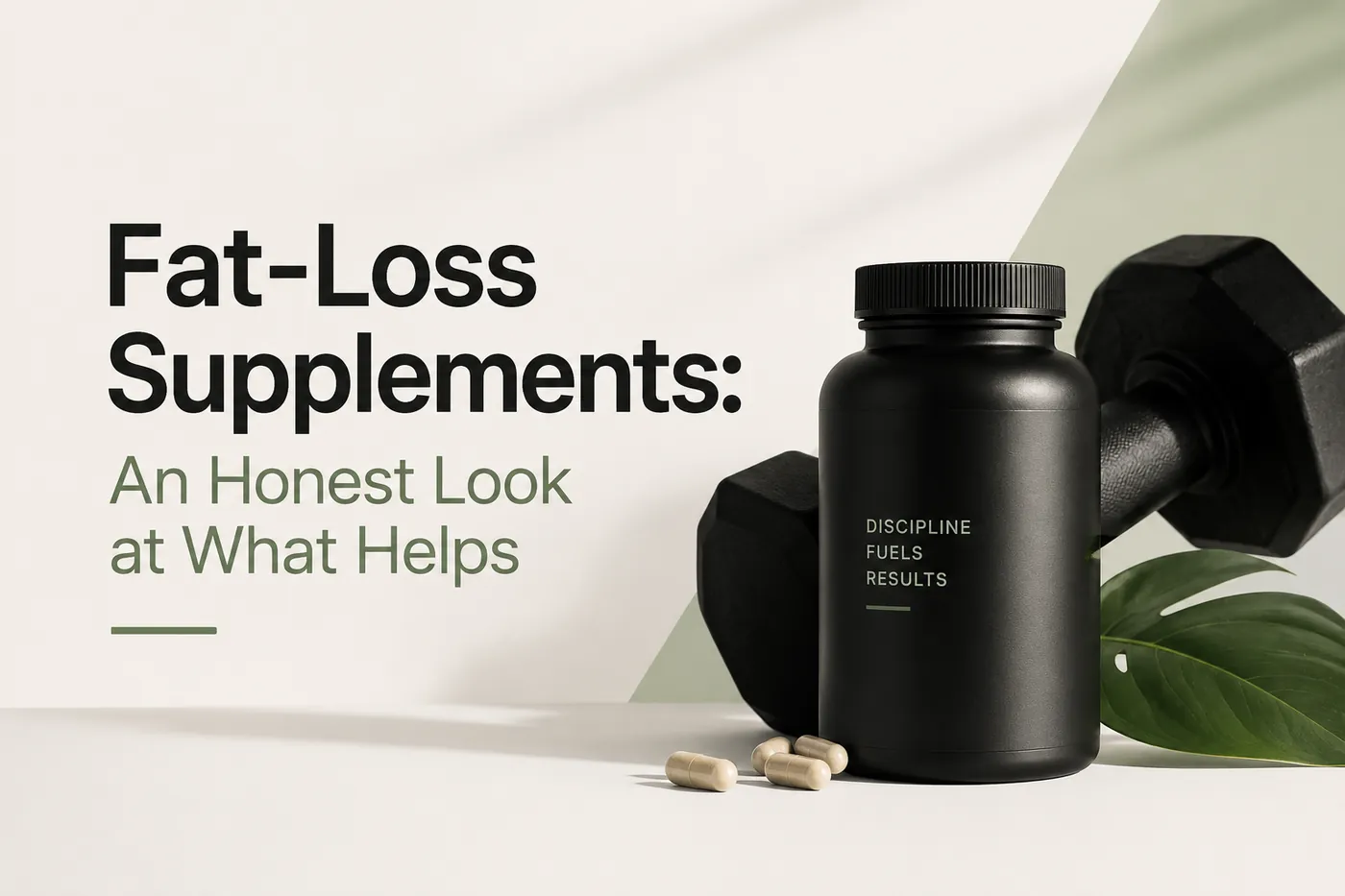
Fat-Loss Supplements: An Honest Look at What Helps
No pill replaces a calorie deficit — but a few supplements offer a modest, genuine edge. We separate the useful from the hype and cover what UAE athletes specifically need to know about fat loss in a hot climate.
The global fat burner market is worth billions. The UAE market — with its fitness-forward culture, year-round gym culture in Dubai and Abu Dhabi, and strong aspiration toward body composition goals — contributes its share. For every genuinely useful product on the shelf, there are twenty that offer nothing beyond expensive urine. Understanding which is which requires cutting through significant commercial noise.
Let us be unambiguous from the start: no supplement creates fat loss. Fat loss is created by a sustained calorie deficit — consuming fewer calories than the body expends over time. Supplements do not change this fundamental equation. What a small number of them can do is make maintaining a calorie deficit marginally easier, slightly increase energy expenditure, or provide modest support to the physiological processes involved. That is a meaningful but carefully bounded claim.
The Calorie Deficit Is the Only Thing That Creates Fat Loss
Before evaluating any fat-loss supplement, this foundation must be clear. The body stores energy as fat when it consistently receives more energy (calories) than it uses. It draws on fat stores when the opposite is true. No compound changes this thermodynamic reality.
What this means practically: a supplement that increases metabolic rate by 5% — which is at the high end of what the evidence supports for any legal supplement — increases daily energy expenditure by perhaps 100–150kcal for a moderately active adult. That is meaningful over months, but it is easily erased by an extra handful of nuts. The supplement cannot do the dietary work for you.
With that foundation in place, here is an honest assessment of what is actually supported by evidence.
Supplements with Genuine Fat-Loss Support Evidence
Caffeine
Caffeine is the most evidence-backed compound for supporting fat loss among legal supplements. It works through multiple mechanisms: it increases resting metabolic rate (by approximately 3–11% in dose-dependent fashion), it enhances fat oxidation during sub-maximal exercise, and it meaningfully improves performance in training sessions — allowing you to train harder and burn more calories per session. Caffeine also suppresses appetite in many users, making it easier to sustain a calorie deficit.
The limitation: tolerance develops. Caffeine's thermogenic effects diminish substantially with habitual use. This is why many serious athletes cycle caffeine — reducing intake for 1–2 weeks periodically to restore sensitivity. Doses of 3–6mg per kg bodyweight (200–400mg for most adults) are effective; higher doses increase side effects without proportional additional benefit.
Protein Powder
This might seem like an odd inclusion, but protein supplementation is among the most evidence-supported fat-loss strategies available. High protein intake during a calorie deficit achieves three things: it substantially increases satiety (protein is the most satiating macronutrient), it preserves lean muscle mass at risk of catabolism during energy restriction, and it has the highest thermic effect of food (approximately 20–30% of protein calories are burned in the digestion process). Maintaining or increasing protein intake while in a calorie deficit is one of the highest-leverage nutrition interventions for body recomposition.
Green Tea Extract (EGCG)
Epigallocatechin gallate (EGCG), the primary active catechin in green tea, has demonstrated modest but consistent effects on fat oxidation in clinical research. It appears to work synergistically with caffeine — inhibiting the enzyme that breaks down noradrenaline, thereby prolonging its fat-mobilising signal. Meta-analyses suggest green tea catechins contribute an additional 75–100kcal of energy expenditure per day. Not dramatic, but real.
Fibre Supplements
Soluble fibre — psyllium husk, glucomannan, or inulin — slows gastric emptying and increases satiety, directly supporting adherence to a calorie deficit. Glucomannan taken before meals has demonstrated the most consistent appetite-suppression effects in controlled trials. The mechanism is mechanical rather than pharmacological: fibre physically creates a gel in the stomach and slows the passage of food, prolonging the feeling of fullness.
Popular Fat Burner Ingredients: An Honest Assessment
L-Carnitine
Carnitine is involved in transporting fatty acids into the mitochondria for oxidation. This has led to widespread marketing of L-Carnitine as a fat-burner. The evidence is underwhelming. The body regulates carnitine tightly, and supplementation in individuals already consuming adequate protein (which provides carnitine's precursor amino acids) typically does not increase skeletal muscle carnitine concentrations sufficiently to affect fat oxidation. Vegetarians and vegans, who have lower baseline carnitine from dietary sources, may see more benefit.
CLA (Conjugated Linoleic Acid)
CLA is a naturally occurring fatty acid found in meat and dairy. Animal studies showed promising fat-loss effects that have not consistently translated to human research. Meta-analyses of human CLA trials report small effects on body fat — approximately 0.1kg per week — that are clinically marginal and inconsistent across studies.
Garcinia Cambogia / Hydroxycitric Acid
Despite achieving significant mainstream popularity, the research on Garcinia Cambogia is consistently unimpressive. Multiple meta-analyses found negligible effects on body weight and body fat that are not clinically meaningful. This is a supplement supported by marketing, not by evidence.
Raspberry Ketones
Raspberry ketones achieved their moment of notoriety through media coverage rather than research. Animal studies at very high doses showed effects that have not been demonstrated in human trials. No meaningful human evidence exists for raspberry ketones as a fat-loss agent.
Fat Loss in the UAE Context
The UAE's climate creates some specific fat-loss dynamics worth understanding:
- Sweating is not fat loss. The abundant sweating caused by UAE heat is fluid loss, not fat loss. The scale weight reduction after an outdoor session in July is almost entirely water — rehydration restores it within hours. This is a common source of confusion when people interpret post-exercise scale changes as fat loss.
- The summer months are actually a high-risk period for fat gain, not fat loss — counterintuitively. Extreme heat reduces motivation for outdoor activity, increases indoor air-conditioned sedentary time, and disrupts sleep (which impairs appetite regulation). Being aware of this seasonal pattern helps UAE residents plan their calorie management proactively.
- Ramadan and calorie deficit: Ramadan creates a natural appetite restriction that many people find conducive to fat loss, provided the Iftar meal does not significantly overshoot daily calorie targets. Prioritising protein at Iftar and Suhoor, managing refined carbohydrate intake after breaking fast, and maintaining training where possible creates the conditions for productive body recomposition during the holy month.
- Heat and thermogenic supplements: Standard fat burner doses of caffeine and other thermogenics carry additional thermoregulatory risk in hot ambient conditions. Exercise appropriate caution with high-dose stimulant fat burners during UAE summer — particularly for outdoor exercisers.
What a Sensible Fat-Loss Strategy Actually Looks Like
Rather than spending significant amounts of money on fat burner formulas, allocate the same budget to the factors that actually drive results:
- A modest, sustainable calorie deficit — 300–500kcal below your total daily energy expenditure
- High protein intake — 2.0–2.5g per kg bodyweight to preserve muscle and manage hunger
- Resistance training — to maintain metabolically active muscle tissue during the deficit
- Adequate sleep — sleep deprivation directly impairs the hormonal environment for fat loss and significantly increases appetite
- Caffeine — a useful adjunct if you are not already habituated; provides real performance and metabolic benefits
If budget remains after those foundations are in place, adding green tea extract or a quality high-protein supplement to support satiety represents the next most evidence-supported layer. Everything else in the fat burner category is, at best, marginal — and at worst, an expensive distraction from the fundamentals that actually work.
View the full supplement range at JNK Nutrition — our team can help you identify products that genuinely support your fat-loss goals rather than just your spending.
Frequently Asked Questions
Do fat burners actually work?+
Depends on the ingredient. Caffeine, protein powder, green tea extract (EGCG), and fibre supplements have genuine evidence for supporting fat loss. Most of the additional ingredients in commercial fat burners — Garcinia Cambogia, raspberry ketones, CLA — have weak or no meaningful human evidence. No fat burner creates fat loss without a calorie deficit.
Is L-Carnitine worth taking for fat loss?+
For most meat eaters, no. The body regulates carnitine tightly and supplementation in protein-adequate individuals typically does not meaningfully increase fat oxidation. Vegetarians and vegans may see more benefit as their baseline carnitine from food is lower.
Can I lose fat during Ramadan?+
Yes. The compressed eating window and reduced appetite during Ramadan can support a calorie deficit. The keys are prioritising protein at Suhoor and Iftar, avoiding excessive refined carbohydrates and high-calorie foods at Iftar, and maintaining some training where possible. Protein supplementation at Suhoor is particularly useful for muscle preservation.
Is the weight I lose sweating in UAE heat real fat loss?+
No. Weight lost through sweating is fluid loss, not fat loss. Scale weight after an outdoor session in UAE heat can drop 1–2kg, but this returns to baseline within hours of rehydration. Genuine fat loss is a slow process driven by a sustained calorie deficit over days and weeks — not by how much you sweat in a session.
How much of a calorie deficit do I need to lose fat?+
A deficit of 300–500kcal per day is the evidence-supported range for sustainable fat loss — approximately 0.3–0.5kg per week. Larger deficits can work in the short term but increase muscle loss, hunger, and the risk of the metabolic adaptations that make long-term dieting harder. Sustainable modest deficits with high protein intake produce better long-term body composition outcomes.