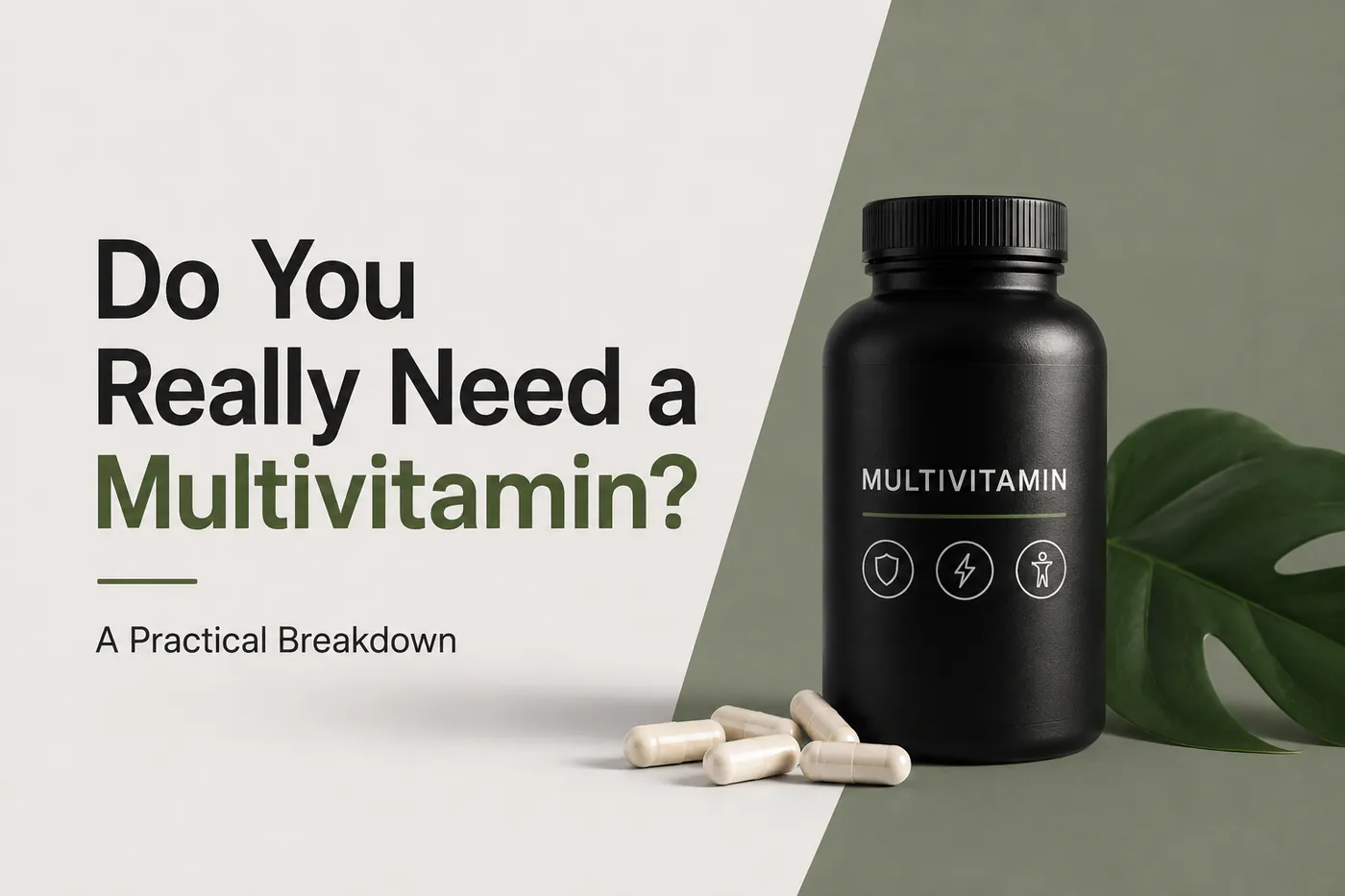
Do You Really Need a Multivitamin? A Practical Breakdown
You live in one of the world's sunniest countries. You are probably vitamin D deficient anyway. Here is who benefits from a daily multivitamin, what to look for, and the specific micronutrient risks for UAE residents.
Here is a paradox that surprises many people: the United Arab Emirates ranks among the countries with the highest rates of vitamin D deficiency despite enjoying some of the most abundant sunshine on Earth. This apparent contradiction — solved when you factor in indoor lifestyles, cultural dress practices, and the extreme UV avoidance necessitated by summer temperatures — is one of several reasons why the "just eat a balanced diet" advice for micronutrients requires a UAE-specific lens.
Multivitamins are simultaneously over-relied upon and under-appreciated. They are not a nutritional insurance policy that compensates for poor diet. They are, for specific individuals and contexts, a practical way to fill genuine gaps that whole-food diets commonly leave open. Understanding whether you are in that group, and what to look for if you are, is worth your time.
The UAE Micronutrient Paradox
Several micronutrient gaps are particularly common among UAE residents, combining both the expat population and Emirati nationals:
Vitamin D
Vitamin D synthesis in the skin is triggered by UVB radiation from sunlight. The UAE receives abundant sunlight, but the practical reality is that most residents spend the majority of daylight hours indoors in air-conditioned environments — offices, malls, gyms, homes — and outdoor exposure often involves UV-protective clothing or sunscreen that blocks the radiation responsible for vitamin D synthesis. Studies consistently find that 60–80% of UAE residents, regardless of nationality, have vitamin D levels below optimal thresholds.
Vitamin D deficiency in athletes is associated with reduced muscle function, impaired immune response, higher fracture risk, worse recovery from exercise, and emerging evidence links it to mood regulation issues that can affect training motivation. For active adults, optimal vitamin D levels (75–150 nmol/L serum 25-OH vitamin D) are considerably above the levels commonly found in UAE residents without supplementation.
Iron
Iron deficiency is common globally but particularly prevalent among UAE expats from regions where dietary iron intakes may be lower, and among women in the active age range where menstrual blood losses create ongoing demands that diet alone may not adequately address. Iron is essential for haemoglobin production and oxygen transport — even borderline iron deficiency without full anaemia (known as iron-deficient erythropoiesis) can meaningfully impair exercise capacity and increase perceived fatigue.
Iodine
Iodine deficiency is underrecognised in the UAE. It is essential for thyroid hormone production, which regulates metabolic rate, energy levels, and body composition. UAE residents who do not regularly consume iodised salt, seafood, or dairy are at meaningful risk. Thyroid insufficiency from iodine deficiency is often misattributed to fatigue, weight gain, or overtraining.
Magnesium
Athletes are at particular risk for magnesium deficiency because sweat losses are high — and in a hot climate like the UAE, sweat losses are persistently elevated. Magnesium is involved in over 300 enzymatic processes including energy production, protein synthesis, and muscle relaxation. Low magnesium manifests as muscle cramps, poor sleep quality, fatigue, and impaired recovery — symptoms commonly blamed on overtraining or inadequate protein.
Zinc
Zinc is lost through sweat and is essential for immune function, testosterone production, protein synthesis, and wound healing. Athletes losing significant sweat volume in the UAE heat face elevated zinc losses. Plant-heavy diets also reduce zinc bioavailability through phytate binding — relevant for vegetarian and vegan athletes.
Who Benefits Most from a Multivitamin
A daily multivitamin is most useful for:
- Athletes in a calorie deficit — eating less total food means consuming fewer micronutrients overall, even with a nutritious diet
- Vegetarians and vegans — plant-based diets are commonly low in B12, iron, zinc, calcium, iodine, and vitamin D
- Individuals with restrictive or low-variety diets — including those who repeatedly eat the same foods due to busy schedules or food preference limitations
- UAE residents spending most of the day indoors — for the vitamin D reasons described above
- Female athletes of reproductive age — iron and folate requirements are elevated
- Athletes training at high volume — elevated micronutrient demands from sweat losses, tissue turnover, and metabolic demands
- Older adults — absorption of B12, calcium, and vitamin D declines with age; requirements for some nutrients increase
Conversely, if you consistently eat a high-variety diet including lean proteins, abundant vegetables and fruits, whole grains, and dairy or fortified alternatives, and you are maintaining healthy body weight without restriction — a multivitamin provides minimal marginal benefit.
What to Look for in a Quality Multivitamin
Not all multivitamins are created equal. The formulation details matter considerably:
- Meaningful vitamin D dose: Many multivitamins include 200–400IU of vitamin D — a dose that is insufficient to correct deficiency. Look for products providing 1,000–2,000IU (25–50 mcg) as a minimum. For those with confirmed deficiency, a dedicated vitamin D supplement at 2,000–5,000IU daily (under medical guidance) is more appropriate than relying on a multivitamin alone.
- Active forms of B vitamins: B12 as methylcobalamin (rather than cyanocobalamin) and folate as methylfolate (rather than folic acid) are the metabolically active forms that do not require conversion — important for individuals with MTHFR gene variants who convert synthetic forms poorly.
- Chelated minerals: Mineral bioavailability varies considerably by form. Chelated forms — magnesium glycinate, zinc bisglycinate, iron bisglycinate — are generally better absorbed and cause less gastrointestinal discomfort than oxide or sulfate forms.
- Appropriate doses without mega-dosing fat-soluble vitamins: Vitamins A, D, E, and K are fat-soluble and accumulate. Avoid multivitamins providing several thousand percent of the RDA for fat-soluble vitamins, particularly vitamin A as retinol.
- Third-party tested or NSF/Informed Sport certified: Quality assurance matters. An independent certification confirms the product contains what the label states and has been tested for contaminants.
Vitamin D in the UAE: Treating the Gap Specifically
Given the prevalence of vitamin D insufficiency in the UAE and the meaningful performance and health consequences, a dedicated vitamin D supplement alongside or instead of a multivitamin is worth considering. Vitamin D3 (cholecalciferol) — the form produced by skin UVB exposure — is the preferred supplemental form and consistently outperforms D2 (ergocalciferol) in raising serum levels.
The most useful first step is a blood test. A serum 25-hydroxyvitamin D test (available through any UAE clinic or through private lab services) tells you your current status and whether you need to correct a deficiency or simply maintain adequate levels. This prevents the guesswork of random supplementation and allows targeted dosing. Most physicians in the UAE will recommend supplementation if levels fall below 50 nmol/L; optimal levels for athletic performance are generally considered to be above 75–100 nmol/L.
When a Multivitamin Is Not Enough
A multivitamin is a broad-spectrum safety net, not a treatment for a specific deficiency. If blood testing reveals a meaningful deficiency — vitamin D below 50 nmol/L, iron deficiency (low ferritin), or B12 deficiency in a vegan — a targeted, higher-dose supplement or medical intervention is required rather than a multivitamin alone. Multivitamin doses of individual nutrients are typically calibrated to prevent deficiency in replete individuals, not to correct it in those who are significantly depleted.
View the vitamins and minerals range at JNK Nutrition — including dedicated vitamin D, magnesium, and comprehensive multivitamin options suitable for active UAE residents.
Frequently Asked Questions
Why are so many UAE residents vitamin D deficient despite living in a sunny country?+
Despite abundant sunshine, most UAE residents spend the majority of daylight hours indoors due to extreme heat, working in offices and air-conditioned spaces. When outdoors, UV-protective clothing and sunscreen prevent the UVB radiation needed for skin vitamin D synthesis. Studies consistently find 60–80% of UAE residents below optimal vitamin D thresholds regardless of nationality.
Should I take a separate vitamin D supplement in addition to a multivitamin?+
For most UAE residents, yes. Multivitamin doses of vitamin D (typically 200–400IU) are insufficient to correct common deficiency levels. A dedicated vitamin D3 supplement at 1,000–2,000IU daily is appropriate for maintenance; confirmed deficiency may require 3,000–5,000IU under medical guidance. A blood test is the best starting point.
Do athletes need a multivitamin more than sedentary people?+
Generally yes. Higher training volumes increase sweat losses (depleting sodium, magnesium, zinc), elevate micronutrient demands for energy production and tissue repair, and make athletes who train in calorie deficits particularly vulnerable to gaps. A quality multivitamin is a practical safety net for any athlete who does not meticulously plan micronutrient intake.
What is the best form of magnesium in a multivitamin?+
Magnesium glycinate and magnesium malate are among the best-absorbed forms and are least likely to cause gastrointestinal discomfort. Magnesium oxide — the most common form in cheap multivitamins — has very poor bioavailability (approximately 4%) and is not an effective way to address magnesium status.
Are multivitamins halal?+
Not automatically. Multivitamin capsules may be made from porcine gelatin, and some vitamin forms are derived from non-halal sources. Look for a recognised halal certification mark, or choose tablet-form multivitamins from brands that explicitly state halal compliance. Several halal-certified multivitamin options are available through JNK Nutrition.