How to Spot Fake Supplements in the UAE Market
Counterfeit supplements are big business in the UAE — and increasingly convincing. Learn the physical signs, digital red flags, and brand verification tools that protect your health and wallet.
The UAE sports nutrition market is large, growing, and — like any high-value category with premium-branded products — heavily targeted by counterfeiters. The combination of high supplement prices, a large fitness-focused population, significant grey-market import activity, and an active informal resale economy through social media platforms creates fertile ground for fakes to enter the supply chain.
Counterfeit supplements are not merely a financial issue. They are a health risk. Testing of seized counterfeit sports nutrition products has found everything from completely inert filler to dangerous undisclosed stimulants, heavy metals, and microbiological contamination. Knowing how to protect yourself is an essential part of being an informed supplement consumer in the UAE market.
Why the UAE Is a Prime Target for Counterfeit Supplements
Several structural factors make the UAE supplement market particularly susceptible to counterfeit products:
- Premium pricing creates large counterfeiting margins. A 2.27kg tub of a premium whey protein retails for AED 250–400 in the UAE. The cost of producing a convincing counterfeit — low-grade protein, recycled or replicated packaging — may be AED 30–60. The margin incentive is enormous.
- High demand and strong brand recognition. Popular brands like Optimum Nutrition, Dymatize, Muscle Tech, and others are well known and trusted — making their branding valuable to copy.
- A fragmented resale market. Instagram shops, WhatsApp groups, and informal sellers at gyms operate outside regulated retail channels where product provenance is verifiable.
- Grey market imports. Products sold as "genuine imports" through unofficial channels may be genuine but past their shelf life, improperly stored, or outright counterfeit.
- Limited consumer awareness. Many consumers do not know what to check or where to verify authenticity.
Physical Signs a Supplement May Be Fake
Inspect any supplement purchase — especially from unfamiliar sellers — carefully before opening and consuming:
Packaging Quality
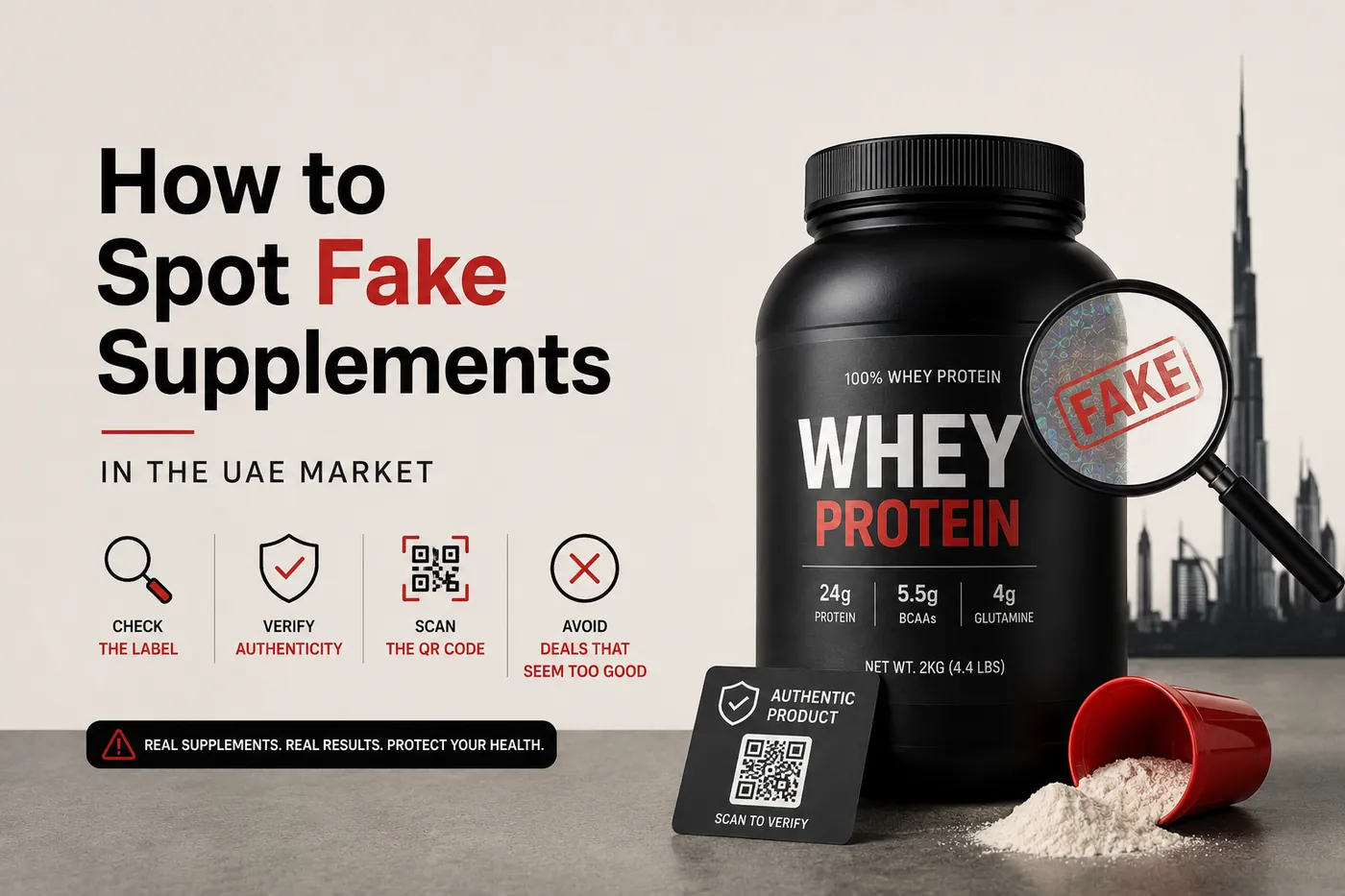
- Label printing: Legitimate supplements use high-resolution printing. Look for blurry edges, slightly off-colour printing, or text that appears pixelated or smudged compared to what you would see on the brand's official website.
- Font inconsistency: Counterfeiters often fail to match fonts exactly. Compare the label font against images on the official brand website. Pay attention to logos — any distortion, scaling issue, or colour mismatch is a red flag.
- Label adhesion: Premium supplements use labels that sit flat and adhere precisely. A label that is slightly off-centre, has visible air bubbles, or peels easily at the edge is concerning.
- Label information: Check for complete nutritional information, proper country of origin, manufacturer contact details, and any required regulatory statements. UAE Health Authority (HAAD/DHA) or imported supplement labelling should comply with local requirements.
Container and Seal
- Lid quality: Premium supplement tubs have lids that close cleanly and firmly. A loose-fitting, rattling, or slightly misaligned lid is a concern.
- Inner seal: The foil inner seal should be intact, smooth, and adhere uniformly around the rim. Resealed products often show evidence of previous adhesion — residue, uneven adhesion, or visible lift marks at the edges.
- Tamper-evident ring: Any product that appears to have had its tamper-evident band removed and replaced — or that is missing it entirely — should not be consumed.
- Batch code and expiry: Batch codes should be clearly and cleanly printed (not handwritten or stickered over). Ensure the expiry date has not passed and aligns with what would be expected from a recent production batch.
Product Appearance and Odour
- Colour and texture: If you have previously used a product and the powder colour, texture, or grind seems different — lighter, darker, lumpier, or more fine — than you remember, this warrants concern.
- Solubility: Quality whey protein mixes relatively cleanly with a shaker. Excessive clumping, gritty residue, or extremely slow dissolution can indicate low-quality protein sources or significant filler content.
- Smell and taste: If the product smells noticeably different from previous tubs of the same product — chemically off, more neutral, or has an unusual flavour — do not continue using it.
Digital Red Flags: Suspicious Online Listings
A significant proportion of fake supplements in the UAE enter through online selling platforms — Instagram, Facebook Marketplace, Dubizzle, and WhatsApp groups. Indicators that an online supplement listing warrants extreme caution:
- Price significantly below market: If a product is listed at 40–60% below its standard UAE retail price, the probability of counterfeit, expired, or improperly stored product is very high. Genuine authorised sellers have wholesale costs that prevent significant undercutting of established retail prices.
- No physical address or contact information: Legitimate supplement retailers operate from verifiable premises. An Instagram-only or WhatsApp-only seller with no physical address is a risk.
- Stock of discontinued products: Counterfeiters often copy products that were popular and then discontinued — because there is no live reference to compare against. Be particularly cautious buying older formulations.
- No returns policy: Reputable retailers accept returns. Sellers who explicitly state "no returns" for sealed products are protecting themselves from authentication complaints.
- Product images that appear stock or copied: Reverse image search the product photos. If they appear on multiple seller accounts or appear to be copied from manufacturer websites rather than actual inventory photos, it is a warning sign.
How to Verify Authenticity
Many major supplement brands provide authentication tools that allow consumers to verify product legitimacy:
- Scratch-and-verify stickers: Some brands apply holographic stickers with a code that can be verified on their website or via SMS. Scratch the panel and enter the code as directed.
- Batch code verification: Contact the brand directly with your batch code (printed on the bottom or side of the tub). Most reputable brands can confirm whether the batch code corresponds to a genuine production run and when it was manufactured.
- Authorised retailer lists: Check the brand's official website for their listed authorised UAE retailers. Purchasing from listed retailers provides the strongest guarantee of authenticity.
- QR codes: Some products include QR codes that link to verification systems. Scan and verify before consuming.
Safe Buying Practices for UAE Residents
The most reliable protection against counterfeit supplements is purchasing from authorised retailers who source directly from official brand distributors:
- Buy from established, licensed supplement retailers with physical premises in the UAE
- Look for retailers who are listed as authorised distributors or retailers on the brand's official website
- Be willing to pay the market price — significant discounts from unknown sellers are a counterfeit signal, not a bargain
- Keep your receipts — legitimate sellers provide purchase records that support any warranty or return claims
- If something seems off after purchase, stop use and contact the retailer before continuing
At JNK Nutrition, every product in our range is sourced directly from official brand distributors and authorised import channels. We do not carry grey-market stock and maintain full traceability from source to sale. When you buy from JNK Nutrition, you receive the product exactly as the manufacturer produced it.
What to Do If You Suspect a Counterfeit
If you believe you have purchased a counterfeit supplement:
- Stop consuming the product immediately.
- Do not discard it — retain it as evidence if you intend to report.
- Contact the brand directly with photos and your batch code to request formal verification.
- Report to the UAE authorities — counterfeit health products can be reported to the UAE Ministry of Health and Prevention (MOHAP) or the relevant emirate health authority.
- Seek a refund from the seller — if the seller refuses, this can be escalated through UAE consumer protection channels.
The supplement market in the UAE is heavily regulated at the import and retail level. The risk comes from unregulated channels. Stay in the verified channel and the risk of encountering counterfeit product drops to near zero.
Frequently Asked Questions
How can I tell if my protein powder is fake?+
Check the label print quality (blurry or slightly off-colour fonts are a red flag), verify the inner foil seal is fully intact, check the batch code against the brand's verification system, and compare the powder's colour, texture, and solubility to previous tubs you've used. Contact the brand directly with the batch code if you have any doubt.
Is buying supplements from Instagram or WhatsApp sellers safe?+
It carries meaningful risk. Informal sellers operating without a physical address or authorised retailer status have no verifiable supply chain. Price outliers — products sold significantly below market price — are a strong signal of counterfeit or expired product. Buy from verified, licensed retailers with physical premises.
What should I do if I bought fake supplements in the UAE?+
Stop consuming the product immediately. Retain it as evidence. Contact the brand with photos and the batch code for verification. Report to MOHAP or the relevant emirate health authority. Seek a refund from the seller and escalate to UAE consumer protection if refused.
How do I know if a UAE supplement retailer is authorised?+
Check the brand's official website for their listed authorised UAE retailers or distributors. Most major supplement brands publish this information. Alternatively, contact the brand's Middle East distributor directly to confirm whether a specific retailer is an approved stockist.
Are counterfeit supplements dangerous to health?+
Yes. Testing of seized counterfeit supplements has found inert filler in place of active ingredients, undisclosed stimulants, heavy metal contamination, and microbiological contamination from unhygienic production environments. Beyond simply wasting your money, counterfeit supplements carry genuine health risks.